
How to start a fire with wet wood in survival situations
There are few moments in the wild that feel as stubbornly personal as trying to light a fire with wet wood. The rain has just stopped, your fingers are cold, the ground is slick, and the forest seems to have made a collective decision to be unhelpful. You strike a match, lean in with hope, and watch it die a watery little death. If you have ever stared at a pile of damp sticks and wondered whether the universe was testing you, the answer is yes — probably.
But here is the good news: wet wood is not a dead end. In a real survival situation, you can still build a fire if you understand how moisture behaves, how to find dry fuel in a soaked environment, and how to stack the odds in your favor. This is not about magical tricks. It is about patience, preparation, and making smart choices when nature is trying to outlast you.
Start by changing your definition of “wet wood”
Not all wet wood is equally useless. That distinction matters. A branch that is damp on the surface can still burn once you expose the drier interior. A log that has been soaked through for days is a different story, but even then, parts of it may still be salvageable. Fire-making in wet conditions starts with observation. Look closely before you give up.
In most survival scenarios, the best approach is to ignore the obvious pieces first. Big logs, shiny bark, and soggy branches look impressive, but they are usually the least useful. Your job is to find the driest material available, even if it means working smaller, slower, and smarter than you hoped.
Ask yourself: where would water avoid? Under thick bark, inside dead standing trees, beneath logs that have been off the ground, or in the center of larger pieces of wood. Nature hides dry material in plain sight. You just have to know where to look.
Look for dry tinder before you touch the matches
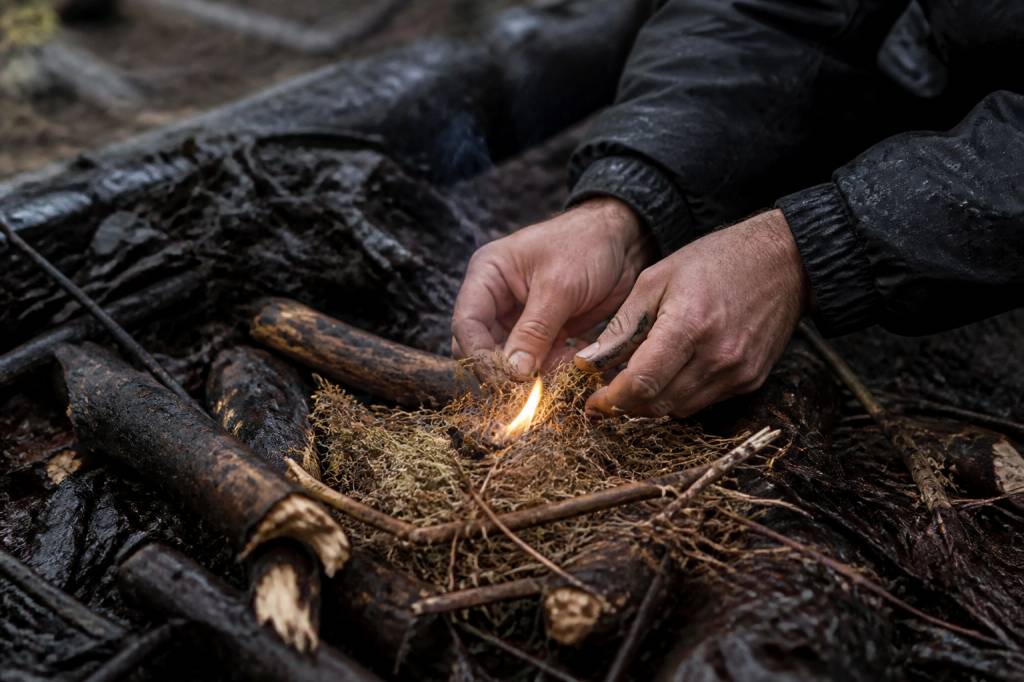
In wet-weather fire building, tinder is everything. Without good tinder, even the best technique will fail. Your first goal is to gather material that catches a spark or tiny flame quickly and helps it grow. Wet wood may be the challenge, but dry tinder is the solution that gets the fire started.
Useful tinder in damp environments includes:
- Dry grass tucked under rocks, logs, or overhangs
- Dead leaves protected inside hollow logs
- Birch bark, especially the papery inner layers
- Pine resin or fatwood from dead conifer stumps
- Dry moss found inside sheltered areas
- Cotton, lint, or other carried fire-starting materials
- Shredded inner bark from certain trees, when local species are known
If you are carrying a survival kit, this is where it earns its keep. A few cotton balls coated in petroleum jelly, waxed tinder, or commercial fire starters can turn a miserable afternoon into a manageable problem. Preparedness is not glamorous, but neither is shivering beside a pile of damp sticks.
Find the driest wood in the area, not the nearest wood
This is where many people make the first mistake. They grab whatever is closest, which is usually the wettest thing in the entire forest. Resist the urge. If you want a fire, you need wood that is both burnable and progressively larger in size. That means building your collection from the driest, smallest material upward.
Look for these sources:
- Dead standing trees, especially the lower branches that are sheltered from rain
- Branches hanging under dense canopy
- Wood inside a dead tree stump
- Branches that are off the ground and not touching wet soil
- Dry material beneath logs, rocks, or root systems
A useful rule: if the wood is lying directly on soaked earth, it has probably been drawing up moisture like a straw. If it is hanging, suspended, or sheltered, it has a better chance of being usable. Dead standing wood is often one of your best allies after rain. It may look unimpressive, but inside, it can be much drier than anything at ground level.
Process wet wood into something easier to burn
Fire does not care about your optimism. It cares about surface area and dryness. That means you should make the wood easier to ignite by processing it. Smaller pieces catch faster. Split wood dries faster. Thin, feathered shavings burn more readily than solid chunks. This is where a knife, hatchet, or even a sharp-edged stone can become a lifeline.
Here is the basic idea: expose the dry inner fibers of the wood. If the outside is damp, remove it. If the piece is thick, split it. If the surface is smooth, carve it. You want the flame to have as much contact with dry material as possible.
Two of the best techniques are:
- Feather sticks: carve thin curls from a dry or semi-dry stick, leaving them attached so they form a bundle of fine shavings.
- Wood splitting: split larger pieces to reach the drier interior, then use the exposed inner wood as kindling.
Feather sticks are especially useful because they create a small, concentrated mass of fine fuel. If a spark lands well, the curls catch more easily than a solid stick would. And yes, carving in the rain is annoying. But so is hypothermia. Survival tends to reward the inconvenienced.
Build a fire lay that gives the flame a fighting chance
When conditions are wet, your fire layout matters just as much as your materials. You are trying to create a structure that encourages airflow while protecting the flame from ground moisture and wind. Think of the fire lay as a tiny architecture project with a very loud payoff.
A good approach in wet conditions is to build your fire on a dry base. If possible, place it on:
- Flat stones
- Dry bark
- A thick layer of split wood
- A makeshift platform of green logs
Keeping the fire off the wet ground reduces the amount of moisture that gets wicked into the fuel. Then create a structure that lets air move through it. A teepee or lean-to layout often works well because it concentrates heat and helps the flame climb from tinder to kindling to fuel.
Start with a small center of tinder. Add pencil-thin kindling around it, leaving gaps for oxygen. Then layer in slightly larger sticks once the fire is stable. Don’t smother it too early. Many fires fail not because the wood was impossible, but because the builder was too enthusiastic with the bigger logs. Fire is not a bonfire contest. It is a negotiation.
Use natural fire boosters when available
In a survival setting, nature sometimes provides accelerants — not in the chemical sense, but in the “this will help a lot” sense. Pine resin, birch bark, and dry fatwood are some of the best examples. They burn hot and can help dry out nearby fuel long enough to establish a stronger flame.
Fatwood, in particular, deserves a reputation for heroism. Found in the resin-rich heartwood of dead pine stumps or roots, it lights more easily than ordinary wet wood and produces a strong, fragrant flame. If you know how to identify it, fatwood can be the difference between frustration and a working fire.
Other useful natural fire boosters include:
- Birch bark strips, especially the papery outer layers
- Pinecones with some resin content
- Dry moss or lichen, if locally appropriate and not protected
- Resin-rich wood shavings
Use these wisely. They are not meant to replace your fuel supply, only to bridge the gap between spark and sustained flame.
Work with your ignition method, not against it
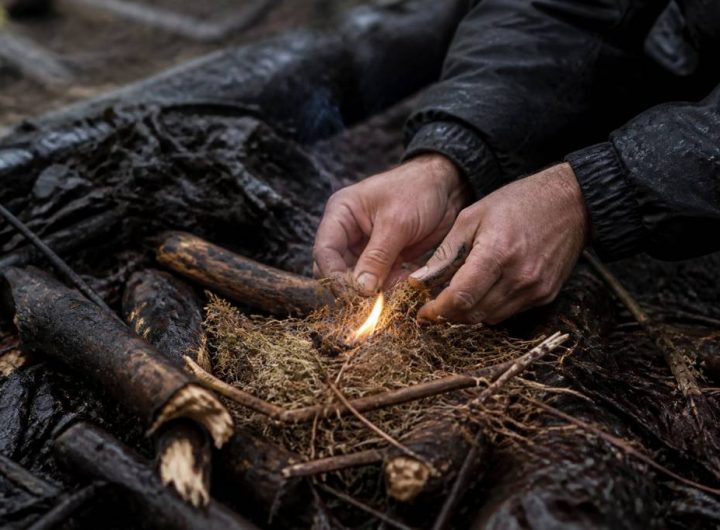
Whether you are using a lighter, matches, ferro rod, or bow drill, wet conditions demand that your ignition method be protected and deliberate. Keep everything dry until the last possible moment. Have your tinder bundle ready before you strike. If your hands are shaking, kneel behind a rock, pack, or log to shield the flame from wind.
If you are using a ferro rod, aim the spark into the finest tinder you have. If you are using matches, strike only when you are ready to commit. With wet wood, there is no room for casual fire-starting. Every second counts.
If your first flame catches but weakens quickly, don’t panic. Feed it with the finest material first. Blow gently and steadily at the base, not directly into the flame from above. The goal is to give the fire oxygen without scattering your tinder into the mud like embarrassed confetti.
Dry your fuel with the fire itself
One of the most useful survival skills is understanding that the first fire does not have to be big. It only has to live long enough to help the next layer. Once you have a stable flame, use it to dry nearby fuel before adding it. This creates a feedback loop: fire dries wood, dry wood feeds fire, and suddenly you are no longer negotiating with dampness.
Place slightly damp sticks near the edge of the fire, not directly in it. Let the heat warm and dry them gradually. Rotate them as needed. Once the surface moisture has gone, move them inward. This technique saves fuel and increases your chances of maintaining the fire through bad weather.
In long wet-weather situations, keeping a small fire going is often easier than starting a new one. If conditions allow, preserve a coal bed. A protected bed of embers can reignite much more easily than starting over from scratch.
Avoid the mistakes that make wet-wood fires fail
Some failures are inevitable in the wild. Others are entirely avoidable. When you are tired and cold, it becomes tempting to rush. That is exactly when mistakes happen. Here are the common ones:
- Using wood that is too large too soon
- Neglecting tinder quality
- Building the fire directly on soaked ground
- Overloading the fire and cutting off airflow
- Ignoring wind protection
- Failing to process wood into smaller, drier pieces
Another subtle mistake is assuming that a fire starter alone will solve the problem. It won’t. A lighter helps, but without proper tinder and kindling, it just becomes a very expensive thumb warmer. The structure and preparation matter more than most people realize.
Practice this skill before you need it
Starting a fire with wet wood is one of those survival skills that sounds straightforward until you try it in real weather, with cold hands and fading daylight. That is why practice matters. If you have the chance, experiment in controlled conditions. See how different woods behave when damp. Learn which tinder works best in your region. Notice how long it takes for small sticks to dry beside a flame.
Local knowledge is especially valuable. Not every forest offers the same materials. Birch bark may be abundant in one region and absent in another. Pine resin may be easy to find in conifer forests but useless where those trees do not grow. The best survivors are not just strong; they are observant.
And if you ever find yourself in the rain, crouched beside a half-built fire while the clouds continue their dramatic performance overhead, remember this: the forest is not asking for perfection. It is asking for patience, preparation, and a little stubbornness. Luckily, those are skills adventure people tend to collect along the way.
So gather the driest tinder you can find, split the wood, protect the flame, and let the smallest spark do its patient work. In wet conditions, fire is less about force and more about finesse. And once it catches, there are few sounds more reassuring in the wild than the first steady crackle of a fire refusing to give up.
 Best survival knives for outdoor adventures
  10 must-have survival tools for any adventure
  Wild foraging: identifying edible plants in the wilderness
  How to make a fire in any weather conditions
  How to handle emergencies in remote locations
  How to stay safe while solo hiking in remote areas
  Adventurous place: the best remote destinations for thrill seekers
  How to start a fire with wet wood in survival situations
  Adventure activities for thrill seekers and outdoor explorers
  The best elevator shoes for men in 2026